The blood starts flowing immediately. I gape at the wound, pulsing to the beat of my heart. My thumb has been torn open at the first knuckle and blood drips down my wrist and onto the floor. I quickly wash the area (the medically recommended treatment) and grab a bandage from my Barbie-pink travel first-aid kit to staunch the flow. Finally, I have time for a breath and to survey the area. Small bits of what used to be me still cling to the blade with its square serrations and evil intent. I calm myself, and continue.
No, I’m not continuing a walk through the jungle being sliced and diced by aggressive vegetation. No, I’m not talking about the splintering boards on the dock in the jungle pond that sent me to the ER – twice – with a massive infection months after the exposure. Instead, my medical emergency happened when I tried to open a container of noodles which I had gotten to go, or glap baan as the locals say. The container was a pretty standard looking grocery store type tub with a lid but it had a catch – both literally and figuratively.
Here, in Thailand, once something is closed it is never to be opened again.
I mean, these things are designed to be opened. It’s just that the design itself precludes opening without damage to the container or, as in my case, to the person attempting to do the opening. For my take-out tub, the trick was a not-obvious-to-the-casual-observer tab that must be broken off the tub thereby releasing enough of the locking mechanism to relieve the pressure on the rest of the lid. Those little catches are the serrations that did the number on my thumb. The release tab is not designed to be removed – so that the entire tub may be recycled – instead remaining attached as a coarse-toothed thumb saw. Say that three times fast.
But Thailand is a country in touch with its long-standing traditions, so this tub design is not unexpected. Way back in the 1960s and 70s, plastic bags arrived on Thailand’s verdant shores (Not like that. There weren’t enough of them. Yet.) and the tradition began.
When you pick up Thai Street Food or Drink it is served in plastic. Fair enough, Thailand has a robust recycling infrastructure whose tendrils snake down the smallest lane to the smallest house so most things that can be recycled, are. The putative trash flows up the tendrils and a bit of cash flows down. It is so pervasive that one of Thailand’s official strategies for dealing with the current onset of the collapse of global society is “to recycle more”. It works pretty well, all things considered, but it does reinforce the pervasive belief that “It doesn’t matter what I do, somebody else will clean up after me”. As a result, absolutely everything is packaged in more plastic than can be rationally justified. If someone (not me, as I carry my own cup and straw) buys an iced tea on the street it will be provided in a plastic cup, with a plastic lid, with a plastic straw, and then slid into a specialized bottom-less plastic bag, with handles, so it’s more convenient to carry the cup. No big deal since most of the waste will get recycled anyway and even the fact that it’s waste is unimportant since the fresh, made-to-order, iced-latte or -tea only costs the equivalent of US$1. But the reason this multi-layered plastic assemblage is even considered takes us back to the aforementioned plastic bags.
In those heady times when the global motto was better living through chemistry and the havoc being played on our endocrine systems by plastic was small beer indeed to the ravages being met out to the lungs of hapless bystanders by Big Tobacco, somebody had the bright idea that if you filled a bag with ice, poured in some tea or coffee, and poked it with a straw, then people could be on their way, freeing up the space around your cart to other customers and cutting down on your dishwashing chores. This somebody realized, probably after the first few attempts, that the bag needed to be sealed to prevent its contents from sloshing out onto the sidewalk or your desk at work.
That someone came up with a quick and easy method to wrap the open bag securely using the same size rubber bands that orthodontists used to use on braces and stretching them enough to get fifty or sixty wraps around the bag guaranteeing that the seal is absolute.
And.
That there was no way in Hell that rubber band was ever coming off.
The hydraulically cinched bag was then put into another for convenience and to contain any slop from when the straw was poked through.
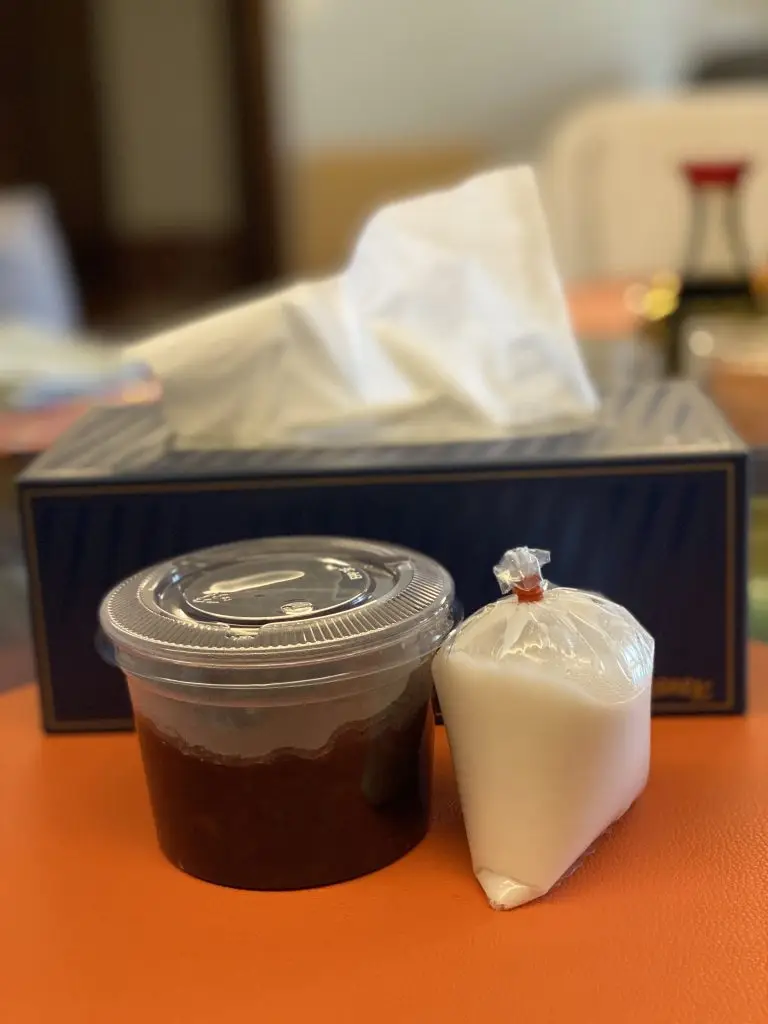
While – mostly – not used in the drinks biz anymore, this technique is ubiquitous in food service. From food on the street to take home from a fancy restaurant, bags of all sizes are filled, spun, and wrapped with a tiny rubber band for their travels. The spinning is key as, somehow, enough air is sucked into the bag that once the rubber band is twisted in place the bag assumes a semi-solid state. Indeed, if you look at the small bag shown in the image at the top (containing a deciliter or so of coconut milk) you will see the tiny rubber band holding back about five atmospheres of pressure.
If I dropped that bag, it would bounce back high enough to catch it.
The drawback, as you might guess, is that rubber band. It is twisted on so tightly and holding back so much pressure that it is nearly impossible to get anything small enough under the wraps to get it off.
Full disclosure: There is a legend that the band has a free end exposed so that if you pull on it the rest of the band will gently unwrap. I call bullshit. In my experience, and in that of everybody I know, this trick doesn’t exist. There is an exposed end. But, when you pull on it, the band just gets tighter.
So, everybody just uses a knife or scissors.
The problem with that is, when it is cut, the rubber band instantly unwinds and shoots across the room, the bag’s pressure drops to local atmospheric, and all rigidity of the system vanishes dumping your pad pak boong all over the table.
Probably the most irritating, on a day-to-day basis, example of this roach motel concept of packaging is the humble cardboard box. The manufacturers really, really, really don’t want you to get inside. Really. And, if you somehow manage that feat, they do everything possible to prevent you from flattening the box to make recycling easier. On that Kleenex box shown in the image the little plastic sheet that the tissues issue from, as well as both ends of the box, are sealed with a glue that was rejected by NASA for use adhering ablative tiles to the heat shields of spacecraft as being “too sticky”. This shit is, in fact, so tacky that the single-layer cardstock the box is constructed from will delaminate before the glue releases its hold on either the cardboard or on the tissue separator. In fact, the glue itself has lower internal strength than its bond with the surfaces it is sticking together.
All of which leads to more chance of injury – cardboard cuts or abrasions from the rough surface of fractured glue – along with the rejection of your recycling due to all the blood making it more like medical waste than merely a box.
I don’t know what this pervasive adhesive is made from. And, like what the tasty sausages I buy from the street vendors actually contain, it’s probably something that I really don’t want to know.
As to the more problematic question of why Thai society is so invested on the functional distancing between product and consumers. I haven’t a clue. The only commonality seems to be the chance of injury from sharp edges to flying rubber bands. But it may be simpler than that given the multi-generational aspect. Any new packaging has all of the problems of the old, and then some. Thailand, as mentioned, is a society of traditions. Maybe the continuity of experience bitching about packaging from one generation to the next is one of the threads that holds the whole place together.
But really, if that’s what they’re going for, forget threads. Just use the glue.