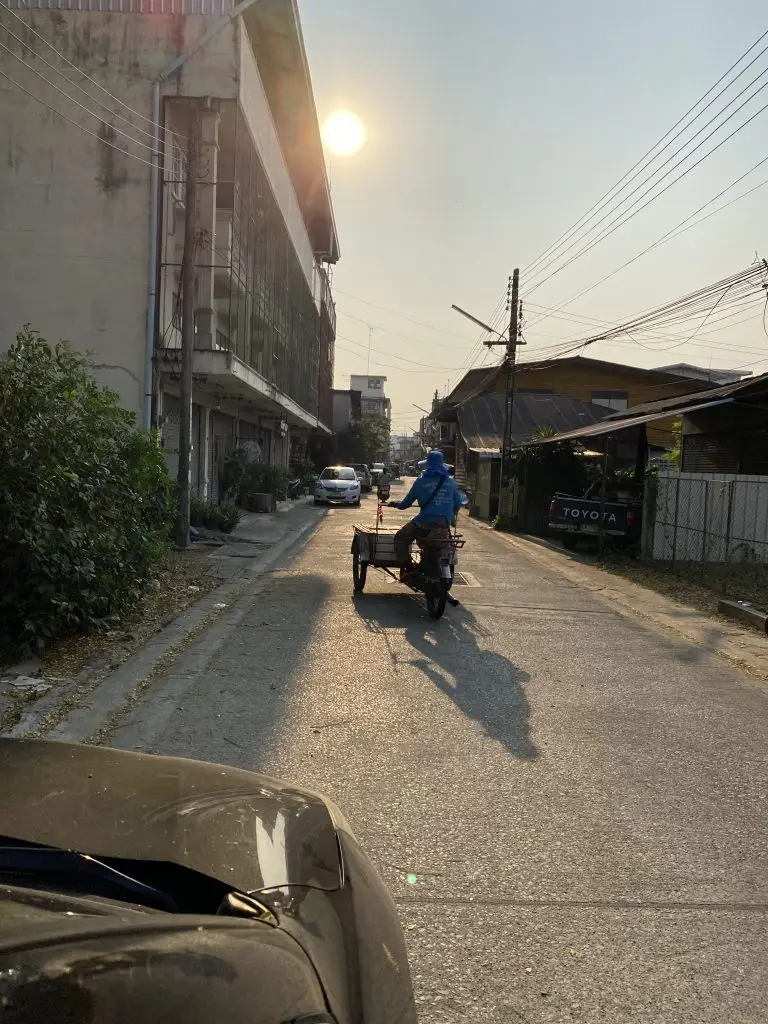
The heat hits like walking into a wall. There is no gentle mixing with the air-conditioned comfort you’re leaving. No warning. Only heat. It is relentless. It feels like it pursues you but also that it knows all your moves in advance. You step into the shade seeking the implied relief and you find the heat waiting. Just. For. You. A brief shower passes and does nothing but raise the humidity. The heat index hovers dangerously ten, or more, degrees higher than the real temperature. And these are Celsius degrees, not those candy-assed Fahrenheit ticks. You drip.
And it’s only the end of March.
As I sit writing this, nearly a month later, I’m comfortably ensconced in a reasonable hotel room right on the beach at Bangsaen Beach. It’s the closest real beach to Bangkok but comes with the decided downside that it’s also one of the beaches downwind of the commercial shipping terminals and anchorage in the industrial waters off Chon Buri. It’s so nasty if I, by means of illustration, were drowning in these waters, I wouldn’t jump in to save me. I went to the beach this morning – which only exists at low tide, thank you global warming – and the sand smelled like fuel oil. I ventured no further. All of that description was just to get to the silver-lining part of the gray cloud: The southwest monsoon seems to be kicking in with a very lively breeze funneling up the Gulf of Thailand. That welcome breeze started yesterday and presages the end of summer.
But wait. You think by way of forcing an explanation. Doesn’t summer start in June?
Like many things in Thailand, the answer to that question is “Yes, but.”
The weather cycles that together make up the climate of our world are governed by the “movement” of the Sun. When the apparent motion of our closest star is toward the equator, then our fearsome scientists decreed that those seasons would be known as summer and winter, said terms applied to the appropriate latitudinal hemisphere. When the apparent motion is away from the equator, then we get autumn and spring. Those are the astronomical seasons and fit the weather changes seen in temperate climates – where all those scientists lived – so made sense. For them.
In tropical regimes, not so fast.
In those torrid terrains the seasons change when the weather does. And that can happen on a single day.
Here in Thailand, there are three seasons – Hot and dry (AKA: summer), Rainy and hot (AKA: the rainy season), and Dry and not quite as hot (AKA: winter). “Not quite as hot” is more along the lines of weather marketing for tourists as the concept of three seasons belies the reality on the ground. Bangkok’s average monthly temperatures range from 26°C (79°F) in December to 31°C (87°F) in April. Remember those are the averages of the monthly highs and lows. The only reason December is cooler is that without a lot of cloud cover the heat dissipates better after the sun goes down.
So basically, the rainy season begins when the sun has moved far enough north to begin warming east-central Asia generating the southwest monsoon which sucks very hot, very moist air out of the Gulf of Thailand and Andaman Sea. The dry season, has more of a fuzzy start as it is determined by when the lowest temperature hits a pre-set trigger point regardless, as that linked article suggests, whether or not the rainy season proceeds relentlessly elsewhere.
But not summer. On one day the northeast monsoon – which brings cool air from China – breaks down and the entire country gets hot. This typically happens in the last part of February into the beginning of March. This year that date was February 22.
What transpires at that time of year is that the sun has moved far enough north to start shining more or less vertically down on Thailand, basically baking everything as there are no clouds to reflect any of the insolation back into space. And, since all of Thailand is south of the Tropic of Cancer, at some point in the sun’s apparent voyage it shines directly down on the entire country. In late-February, at Bangkok about 13 degrees north latitude, the sun is within 21 degrees of vertical and remains at least that high until sometime in mid-October. But, forget the heat for a minute. It’s those two days a year where the sun shines vertically down that I’m interested in.
They’re called zero shadow days. And they are weird.
We humans are visual animals and we get all sorts of clues from our eyes. Shadows are an important component of those clues. We use them to gauge size and distance, directions and navigation, even the time of day. And when that set of clues disappear the world changes.
It’s, obviously, not that the shadows “disappear”, but for a few minutes a day for a very brief time of year an object’s shadow is entirely contained within that object’s footprint. Anything regular and vertical, power poles, pipes, houses, cars, skyscrapers, whatever, are uniformly illuminated on all sides. But, since the light rays from the sun are coming in vertically, they merely glance the object’s surface. All other illumination is from reflected light. As noon approaches, the shadows shorten. Once the sun is within a couple of degrees of vertical (so, four solar diameters as seen from earth) that reflected light takes over.
And the world starts to sparkle.
But there’s a problem.
As you recall, for about two and a half months, the sun has been boiling off the upper layer of the tropical seas and then all that moisture gets sucked north by the monsoon leading to nearly constant cloud cover. That monsoon is starting now and will be well established by Monday, April 27, 2026 – this year’s first ZSD in Bangkok – most likely blocking the sun with high clouds and leaving those of us hoping for a glimpse of the sparkle waiting for the sun’s return in August. A wait that, also, will likely end in disappointment as the rainy season will be in full deluge by then.
It is a quixotic quest, indeed.
My only hope is that, human angular perception and the sun’s apparent motion being what they are, I will have a few days on either side of the Zero Shadow Day where at least some of the sun’s rays will be shining vertically down on my neighborhood. It’s not the real deal, but, given that it’s Thailand, good enough is sometimes the best you can hope for.
And, just like that it changes. I’ve written the above on April 20. It’s now the day after and thunder fills the skies. I’m still amazed at how quickly the seasons change here but overnight the rains have begun. I know it’s just the Universe warning me about making plans but, really, couldn’t it have waited a week?