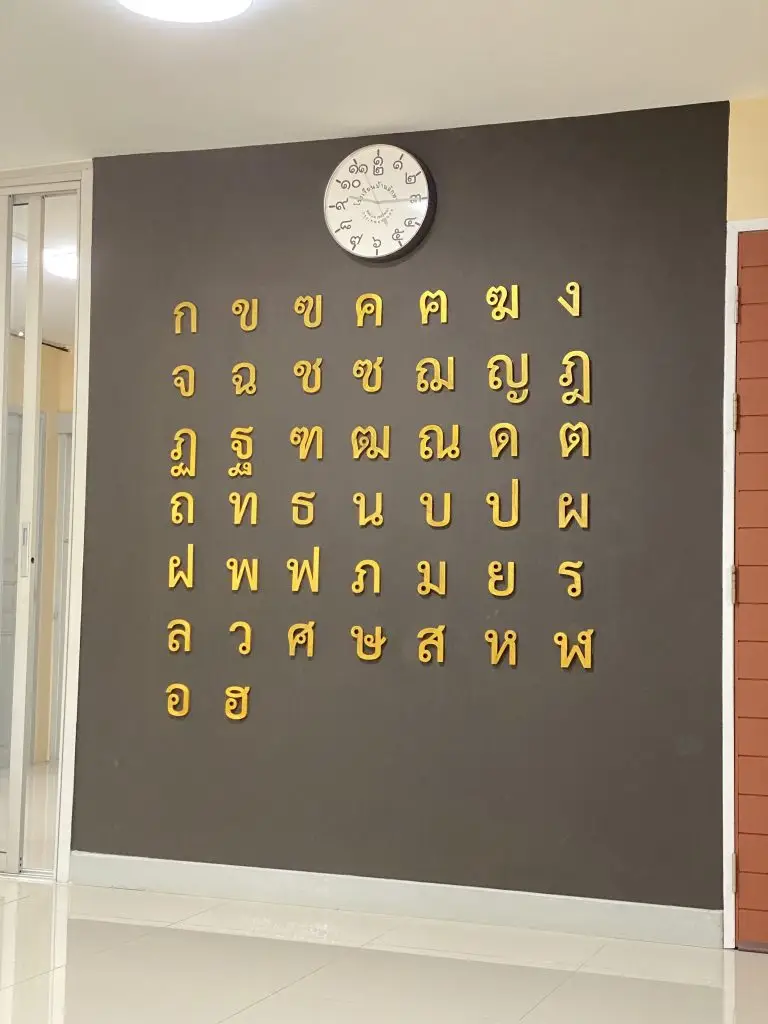
Nearly fourteen years ago I introduced you to the Thai language and all its complexities as viewed through the eyes of a total newbie. Now, after a dozen years of formal and….
Wait just a minute there. You’ve been studying Thai for over a decade?
Yup.
And you’re still at it?
Yup.
Are you nuts?
As I was saying…
Now, after a dozen years of formal and informal study I can finally say,
I know nothing at all.
I guess you just answered the question.
Indeed.
In those heady days of yore when Thailand was bright and shiny as a new penny, my focus was on the Thai alphabet (really an abiguida – look it up) with its forty-four consonants and twenty-three vowels, various mystical addenda, and all the possible sound combinations you can make with them. Ha, ha, ha, ha.
Ha.
And its five tones. Hā. Hà. Há. Hâ. Hǎ. And how they, combined with the 6.3 followed by 37 zeros different arrangements of consonants and vowels, yield a number of possible sounds in the Thai language that dwarfs the number of stars in the Universe by a factor of the number of stars in the Universe.
Clearly, I was missing something.
So, I began my studies. An effort which told me the thing that I was missing wasn’t a way to simplify things but, in reality, multiple different, and unrelated, ways to make it more complicated.
The good news is that the alphabet is “simpler” in the fact that the forty-four consonants only make twenty-one different consonant sounds. The bad news is that there are 23 consonants that make the same sound as some other letter.
The good news is that there are only twenty-three vowel symbols. American English with its mere six (sometimes y) can nevertheless come up with about 16 different vowel sounds. That seems ballparky. Except those twenty-three Thai symbols can make some thirty-two different sounds.
And those numbers do not factor in the tones (3.35 million).
So how can a language built by assimilation of neighboring writing systems and codified by royal edict at the end of the 18th Century, spoken by millions in one of its many dialects, yet mostly passed down by word of mouth over its total 700+ year history, be so complicated.
It all boils down to – and my fingers are aquiver as I write this – Rules.
I have written before about my intimate relationship with rules. Some rules are absolute. These have been set down by the Universe as foundational testaments. Some are the ones I use to guide my life. Chief among these is: “Rules are for other people”. Ironic, amirite? Some, like, “Always Signal Your Turn”, are there as a reminder that you are not alone on the planet and everybody else are not NPCs despite the fact that you they appear to be.
Thus it is with the Thai language. All of the massive numbers, all of the cryptic symbols, all of the sounds furiously signifying something are kept herded and moving along like so many cats, by the Rules.
As with everything, there is a First Rule which states: There will always be exceptions. This rule is shared by all languages given their, ultimately, common origin. As languages evolved, this spread and today’s rules range from “that ‘g’ thing” in Spanish to the “well, pretty much everything’s an exception” that is American English. Thai is somewhere in the middle of that.
Thai starts out by naming all their rules something that roughly translates as “Just get over it, that’s the way we do it”, and in their Second Rule they split the consonants into three classes. High, middle, and low. (Which in a remarkable coincidence are exactly what they are called in Thai. Except in Thai.) These classes break up the alphabet into three groups to allow the next rule to kick in “The purpose of the classes is to make it easier to determine the tones”. Unfortunately, the number of letters that make the same sound as another is so great that it is nearly impossible to guess how anything is spelled without already knowing how it’s spelled. I mean there are six different ways to make a “K” sound spread across two classes. In fact, except for letters that make “G”, “J”, “B”, “Bp” (say them both at the same time and you’ll be close), Ng (Say “sing”. Now say “ing”. Now say “ng”. See? Easy.), “R”, and “W” sounds, all the others share their sound with at least one other symbol. Sometimes even in the same class. So, this Rule says If the class is X and the vowel type (long or short) is Y, then this is the tone. The result is a simple three-by-four grid. With only one exception.
Hey, wait! You said this was going to be complicated. One exception is easy.
Ahem…
Except.
If a certain high-class consonant (ห – haw heeb, if you’re curious) precedes one of eight low class consonants, then the high-class consonant sets the tone rule but is not spoken. Sort of like the P in pterodactyl or the “S” in ChatGPT. This takes our simple grid and basically turns it into a 4 x 4 (with one exception) except eight of the letters are repeated in two different groups.
Except.
The history of the Thai language traces back some 2,569 years to when the Buddhist canon was first set to paper, or whatever they wrote on back then. The Thai alphabet was devised so that those original scriptures and all that followed could be read in the original Pali/Sanskrit they were written in. Other words also entered the language which, if read as written, would not have the correct tone. So, tone marks were invented. These are little glyphs that hover over the first “consonant” of a syllable – á la, น้ำ (where it’s the hovering mark at the top) – which overrides whatever the tone rule would otherwise demand. And makes it something else. In that example it changes a mid-tone into a falling tone. Some 40% of words in Thai invoke the tone with a tone mark rather than change the way it’s spelled because that’s the way it’s always been spelled.
Hey! Why’d you put scare quotes around “consonant”?
Because…
Thai is a monosyllabic language. What this means is that words are not important, all the rules apply to syllables which are then used to build words. The basic syllabic structure is C1V(C2) where a consonant (C1) and vowel (V) are mandatory, but the second consonant (C2) is optional. C1 can be played kind of fast and loose. It can be a single consonant, or it can be a consonant cluster. A consonant cluster is simply a group of two or more consonants in which the sound of each letter is preserved. The “st” in star is a cluster, the “pt” in kept is, but the “pt” in pterodactyl isn’t. In English there are dozens of clusters – str, pl, br, etc. – that can start a word. There are hundreds more – ts, lds, mps, etc. – that can end one. In Thai there are a total of fifteen clusters which may only appear at the start of a syllable.
Fifteen seems manageable…
Yeah, right up until you encounter a false cluster and need to apply a completely different rule. Oops… rules, I meant to say. There are an endless number of these and they’re subject to different rules only because they’re not one of the fifteen. So, things like the “sr” in sriracha is just “s”. But, in Thai, “Starbucks” would be pronounced “satabak” because “st” is not one of the fifteen, and you can’t end a syllable with an “r” or “s” sound.
Well, you could write it, you just couldn’t say it.
Because…
Thai has only eight sounds that can end a syllable. However, there are some thirty-five consonants that can be written in that end position. That means you’re tasked with remembering rules that syllables that end in “l” really end in “n” and syllables that end in “j” really end in “t”. And thirty-three more.
Then, that pesky C1 in the starting position is sometimes silent. It needs to be written but maybe not said.
You be trippin’?
No. At least not yet.
Some syllables start with a vowel sound when grammatically you can’t start a syllable with a vowel symbol. The clever Thai people got around that by inventing a silent consonant, อ (aw ang), which, when in the C1 position is only a placeholder but can support a vowel or tone mark associated with it. This allows Thai kids to be named things like “Ice”, “E”, or “Iphone” and still be able to spell their names.
And, of course, just to confuse things further, อ aw ang, can also be a vowel.
Wow, just like “y” can be a vowel, right?
Yeah, almost.
Hey! What about the vowels?
Oh, yeah… About those vowels…