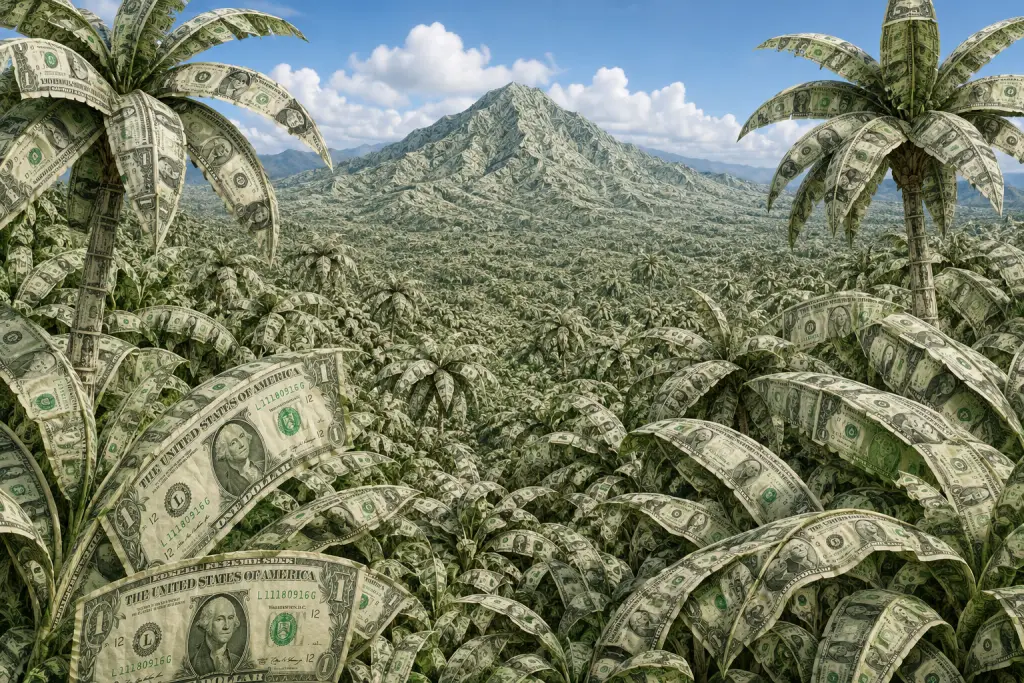
Money has been in the news a bit recently and given the paucity of resources financial I struggle under and my interestobsession with happenings economic and pecuniary, I thought it would be a good time to revisit the subject. If we look back a third of a century ago (yes, you are that old) to when the Barenaked Ladies song borrowed for the title was released, a million was a fair amount of money. Even in Canadian Dollars which is what they were talking about in the song. The group was able to spend 4:27 talking about all the wonderful things they could do with a mega-buck and would probably end up with some change.
Time flies, doesn’t it.
A couple weeks ago we minted the world’s first trillionaire: AKA – $1,000,000,000,000.00. A number which has actually increased slightly since then, by about $100,000,000,000: AKA – More Money Than God. In any event, a lot. So, let’s dive into this a bit deeper.
First, some context.
A US$1.00 bill is 0.11mm (0.0043 inches) thick. A stack of one hundred of them is 1.1cm (a bit less than half an inch) tall. A thousand is 11cm (4.3 inches). A trillion is one hundred ten thousand KILOMETERS (68,350.83 miles) tall. That’s about a third of the distance from the Earth to the Moon.
The clever one among you realized that a stack of bills like that would probably tip over and scatter into the ether long before it reached low Earth orbit. So, let’s lay that peta-buck end to end instead. Now, safely resting on whatever imaginary substance is available in deep space, that same amount of money would extend from the average location of Earth’s orbit to the average location of Mar’s orbit and back with enough left over to do the Earth-Moon round trip about twenty-six times.
It’s a lot.
But again, some context is required.
That same trillion dollars, should Elon ever decide that fixing Earth is a more noble goal than allowing humanity to die off on two different planets, could barely fund the US Government between October first, when the budget year resets, and November 21 at 5:23pm. In that context, that trillion dollars would keep the government going for the same period of time that I burn though about three grand. (33cm/12.9in).
Which brings us all back to the question: What is money and why do we attach such importance to it?
The first part of that inquiry is easy – money is nothing. There is nowhere in the known or unknown universe where you can walk into the woods, turn over a rock, or find a tree with money on it. It doesn’t fly with the birds, swim with the fishes, or walk along the beach with a pina colada and a tiny paper umbrella.
It’s just not real in the same way a squirrel, egret, or their respective droppings would be. It isn’t real. And it’s simple to show this despite your head screaming in protest that all those years you spent acquiring more, were, essentially, wasted.
Just a quick aside. I don’t write these all in one sitting even though they might seem like a grammatical rush-job. In the intervening few days since I typed “wasted”, Elon’s net worth has increased by yet another two hundred billion. This has brought his total gains since the SpaceX drop to a bit more than the World’s Second Richest Man’s (AKA – First Loser’s, because you’d have to search to find out who it is) total net worth. Elon’s financial statement now totals more than the first five losers’. Combined.
Continuing. The second part of the question is the place we’ll have to start to make any sense of my pre-aside, money-is-nothing assertion. There are three separate, but related, concepts involved. All three are subject to frequent conflation and the resulting confusion is really at the heart of the Emperor’s New Clothes period of history we find ourselves in.
The first concept is value. Value is the foundation upon which all else is built. Value is real. It is an innate property of life and one that can be traced back hundreds of millions of years and across taxonomic boundaries. Why do I consider value to be real? Because you can see it with your own eyes, right now. When a chimpanzee finds a particularly nice rock and carries it around despite the encumbrance of not having pockets, that’s value. When crows pick up shiny bits to incorporate into their nests as decoration, that’s value. Hermit crabs picking out a new shell and deciding on one despite other – apparently equal – shells being ignored, that’s value. The detritus in an octopus’s garden – value. And when, in some pre-troglodytic moment one of humanity’s furry progenitors turned over a rock in a distant stream bed and found a small nugget. Value.
Value – all by itself – was the origin of the first barter-based economic system. My bushel of quinoa is valued – by me – the same as two of your fishes plus that orange.
At some point, some group realized that there needed to be a better way to assign value, particularly for items like fish and oranges which don’t last in your wallet for very long, and money was invented. Humans have used many things for money from metal to seashells to giant rings of stone, but all these things shared a few common things. First, they were durable. Ice would not be my mineral of choice for money. Next, they were reasonably scarce. There was enough of the material to not run out but, at the same time, it was hard enough to find that the effort of getting it, processing it, transporting it, whatever, made it at least enough of a pain in the ass that just going into the woods and turning over rocks wouldn’t make up the entire population’s job. Lastly, most everyone in the group had to agree that there was a store of value in the selected material and accept it in lieu of quinoa in transactions.
And that agreement – that a third material can stand in for any number of other commodities, services, labor hours, whatever – is the basis of wealth.
Next in line is worth. Consider that if I have something – my bushel of quinoa – but I want something else – say a Roland D-07DMK electronic drum kit – how do I figure out whether the drum kit will be of more value to me than the quinoa? Being a boring, analytical type, I decide that not dying during the winter because I can put quinoa on the table is a better choice than pounding along with Life During Wartime as I slowly starve.
That comparitive value is worth. It is a very personal decision as different people will decide different worth based on their personal circumstances. And, it’s the one where each person interfaces with the worth decisions of everybody else. If I’m trying to sell my drum kit and nobody else thinks it’s worth what I do, then I’ve got a drum kit for life, and I’ll spend my last days trying to get Wipeout right.
But things aren’t quite that simple. We no longer have a commodity-based currency system. There is nothing behind that one-dollar bill – no gold, silver, or quinoa – that gives it any intrinsic value. There isn’t enough of any commodity to cover the need for all the money the system needs. So, that one-dollar bill is backed only by the agreement that it’s worth, ironically enough, one dollar. Absent that agreement, it’s worthless.
So, Value + Agreement = Money, Value + Choice = Worth, Money + Worth = Zero. Since both worth and money are agreements, they are not real.
All this boils down to that worth-interface I spoke about two paragraphs up. That is where the agreement is made. And it’s not just about the agreement that money is valuable. It also assigns the value of everything else that is sold, bought, or invested in on the planet. Those billions of agreements are the economy. They determine the price of everything. And when you total up those prices it squares the circle and provides a measure that we call wealth.
Elon’s trillion is merely denominated in terms of money. It doesn’t mean he has that much money – in any form. It doesn’t mean that he could access that much money, or anything close to it. It doesn’t even mean that he could write a check that wouldn’t bounce. His wealth is only the sum of the agreements and estimates of all the things he owns. And not one cent more.
If you want an example of what happens when all those agreements are revealed for what they are, just look back twenty years when the economy was buoyed by subprime mortgage agreements floating on a sea of overvalued housing.
As long as we agree that the Emperor’s SPCX is worth a lot, Then Elon keeps his crown. But, when that kid at the back of the crowd shouts out that SpaceX – in its history – has never made a dime…
Don’t be standing near the exits.