Whenever I start a road trip, which I have done on every continent except Antarctica because, no roads, I ask myself one very important question: Where am I going? Why, which rules over every other decision I make, never even enters my mind. I am going because I have to. Because, genetically speaking, my so-called “junk DNA” actually codes for downloads of the entire Rand-McNally catalog, every Lonely Planet Guide, and a full set of the Texaco road maps from the 1950s for back-road planning. Road-tripping is not just in my blood. It’s in my everything.
One could say that this is the route of all my problems.
Sorry.
Once I know where I am going, my next question becomes: Will I survive the trip? So far, my assessment and reality have aligned quite nicely, but that is never guaranteed. It’s best to start out with a clear, steely-eyed vision of what my vagabond wanderings might hold in store for me. Strip away the tourist fluff and give me the cold, hard facts.
So it was in Thailand. Early in my travels here I had many chances to observe how professionals do it. Every one of these observations ended with me leaping from the vehicle and kissing God’s (or, well, you know) Green Earth. I learned the Bangkok Ooze, where one signals a lane change, drifts slightly that way blocking two lanes, and then waits to see which lane is actually moving faster. Everybody does this. I learned The Rules, which are pretty much like everywhere else but largely ignored. And I started to learn the rules. Those little cultural differences, the implied understandings, and the little polite behaviors that make driving in a country possible when there are more vehicles on the road at any time than there are people available to drive them.
I learned that the basic rule of the road is: Don’t hit the other car. This is a big one. It means that in a city like Bangkok, you are in an environment that is basically a 1,600 square kilometer (figure it out, it’s easy) bumper car ride where everybody is aiming for the spaces between the cars and not trying to send the other drivers to the local Cervical Trauma Center. This allows you to squeeze into spaces that would get you shot at in the US and not worry about the gun part. It looks, to the casual observer, like chaos with lane-splitting, people cutting each other off, and constant near misses. It’s really more like a dance. Everybody is trying not to hit anything and accepting the vehicles squeezing in front of them because sometime, sooner or later, they’ll have to do the same and they’ll need the credits on their pay-it-forward tab.
Then there are the lanes. Striping is to global standards to help the many foreign drivers with their international cargos. That is, when they eventually bother to put some paint down. I have driven on roads that were supposed to be ten-lane highways that had exactly no paint on the surface. In my experience since then I can only assume that the painting department was busy elsewhere for the few months between when the road was ready for use and the time the painters’ schedule had cleared. This is not uncommon and the ever-resourceful Thai drivers adapt to the situation immediately turning the presumptive ten lanes into an easy twelve and moving 20% more traffic until the painters show up.
Another factor that needs to be considered are Ghost Riders. These are (usually) scooter riders that are going against the main flow of traffic just to save some distance compared to safely running up to the next U-turn and proceeding with the flow of traffic rather than against it. During my earlier green scooter trip, I was confronted with a conga line of pickup trucks doing the same thing. At speed. Full disclosure: I, too, have Ghost Ridden. But just a little.
All of which conspire together to give Thailand a reputation for being a deadly if not merely dangerous place to operate a motor vehicle. Dangerous, that is until you look at the… ahem…
Statistics
Oh, come on. You knew that was on the way.
At first blush, the statistics bear out the implied danger. But when you look closer, as I like to do, you can understand the situation better and use that understanding to optimize your go/no-go decision matrix.
First, Thailand is the only country I know that has not one, not two, but three holidays which are nicknamed “The x deadly days”, with x being dependent on the holiday and if Thailand decides that this holiday needs more days, or whatever. So, not road tripping during those deadly days can greatly improve your odds of not becoming a statistic.
Second, the statistics cover a broad age group. The middle, and largest bracket, is a full twenty-six years. When you look closely, the lower end of that group is made up of people who are male, home for the holiday, hanging with their old school buddies, and drinking and/or smoking pot. That’s all before they go out riding with their other prefrontal cortex challenged peers and racing their hopped-up scooters off cliffs and parking their tuned Izusu D-Max pickup trucks halfway up a tree up in Nakhon Nowhere. Your odds improve greatly by staying off the road when they are working on their hangovers. Wait to travel when they’re sleeping them off.
Of note, more recent statistics show a substantial increase in traffic fatalities in my age group, which starts at 45. <Blink> <Blink> I’m pretty sure this is due to people like me buying scooters like mine. Nothing I can do about that, though.
Lastly, do everything you can to be “safe”. Never at the expense of fun, but still. Make sure your vehicle, particularly a two-wheeler, is lit up like an aircraft carrier during shore leave. Be visible and be aware.
All of which sounds very Dad, particularly coming on the heels of last time’s statistical analysis, but if you follow those rules you are, statistically speaking, going to come out all right.
Wishful thinking? Maybe. But, as I related in my previous post, who cares?
Then there are the Thai drivers. Sure, they drive on the other side of the road, compared to most of the world. Sure, they will give you a few centimeters when you need a few meters. Sure, they will cut the queue and double-lane a one lane U-turn. But they also manage to do four-way intersections with no lights or signs or anything but closing their eyes and hoping that their pay-it-forward account is fully topped up.
Unfortunately, they do three things that are completely maddening. First, they, particularly when on motorcycles, come shooting out of side streets without slowing or looking – at anything other than their phone – to see if there might be a multi-tonne (2,200 lbs. Whoa! See how it all makes sense?) delivery truck whose driver is, karmically, watching the same YouTube Lisa video as the soon to be scraped off the asphalt into little labeled bags encroaching motorcycle rider.
Second, they, particularly in cars, come creeping out of side streets as if they have given up any hope of catching their turtle. They exude into spaces that would easily accommodate the twenty or thirty cars stacked up behind them, and finally, seemingly weeks later, they enter the flow of traffic. And continue to drive at that same speed! Eventually, after many hundreds of meters, they look up from their phone and have that Eureka! moment. They remember what that other pedal is for and off they go.
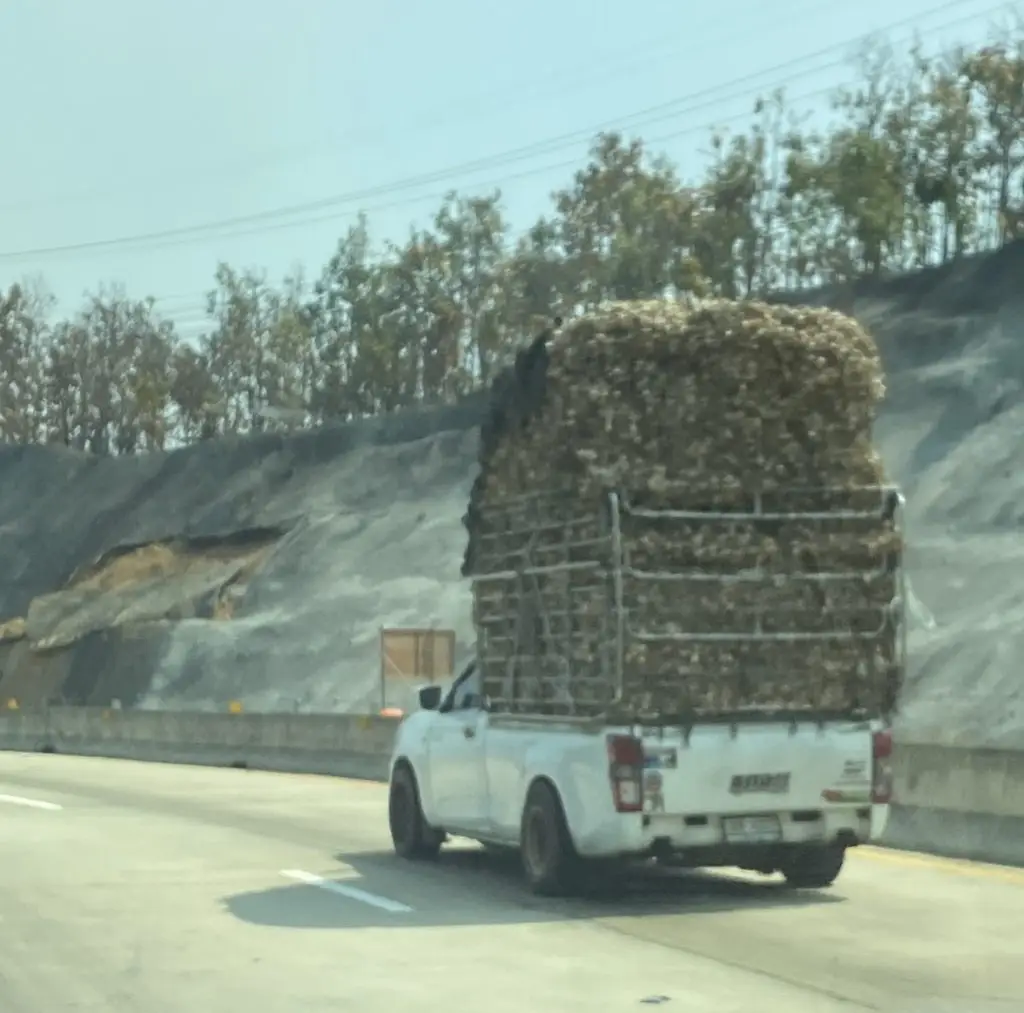
Third, Thais love to drive fast. Go out on the highway to the airport any morning at 4am and there will be an alarming number of exotic sports cars priced at many millions of Baht each zipping along at speeds that the highways in Thailand were definitely not designed for. Somewhat counterintuitively, Thai drivers also hate to pass. On any road with more than two lanes they will come speeding up on your right until they get into your blind spot, whereupon they immediately match your speed. Inching (centimetering just doesn’t ring, amirite?) forward, they eventually get by and immediately resume their earlier velocity. On roads with only two lanes the need for speed and the fraidy-cat passing behavior collide and indecision wins out. They sit and wait patiently until the farm truck, piled alarmingly high with garlic, finally makes its turn or breaks down.
It’s into these conditions I insert myself onto the Thai highway system on my ridiculously underpowered scooter. Empowered by the wisdom of many years of careful observation and more than a few close calls, I hit the starter and hope that fate, once again, smiles on me. I understand the risks but, when it comes right down to it, it’s not like I have a choice.