I should know better by now. I mean, really, with dozens and dozens of posts in The Old Blog – that intricate memoir of a past that will follow me forever – detailing my utter, complete, and inexorable march to botanical failure as a micro-farmer, my caring-as-a-shot-of-Raid life with the bees, and a dozen-year attempt to justify keeping chickens in a lifestyle that cost more to keep them cozy and happy than I’d ever get back even selling the eggs at seven bucks a dozen, I can see one thing clearly.
I haven’t changed at all.
Exactly a year ago I stepped off the plane into Suvarnabhumi Airport (which is spelled in our alphabet nearly nothing like it sounds in Thai) following a trip from Miami, Florida, USA, and was immediately slapped in the face by the metric tons of cold air being pumped into the arrival terminal to keep the just-arrived alert and awake, and to avoid the meltdowns that occur once the weary traveler exits the climate controlled confines into the damp, Cretaceous heat of Bangkok and tries to get a taxi. Between the slap and the soggy there is one of the longest walks available for an arriving passenger anywhere in the world. Luckily, the helpful people at Airports of Thailand, the managers of the airport, have adorned that long trek with thousands of square meters of…
…orchids, Thailand’s ubiquitous flower.
As I took in the floral profusion, I thought to myself: Wow! If they can pull this off when air-conditioned to the temperature of dry ice…
…how hard can it be?
Which are the exact words that rationalized my initial venture in micro-farming some fifteen years ago.
And we all know how that turned out.
I detect a trend.
Ultimately, my passport having been stamped and my luggage whisked past Customs with its various contraband nestled among what was left of my cold-weather clothes, I gave it some thought.
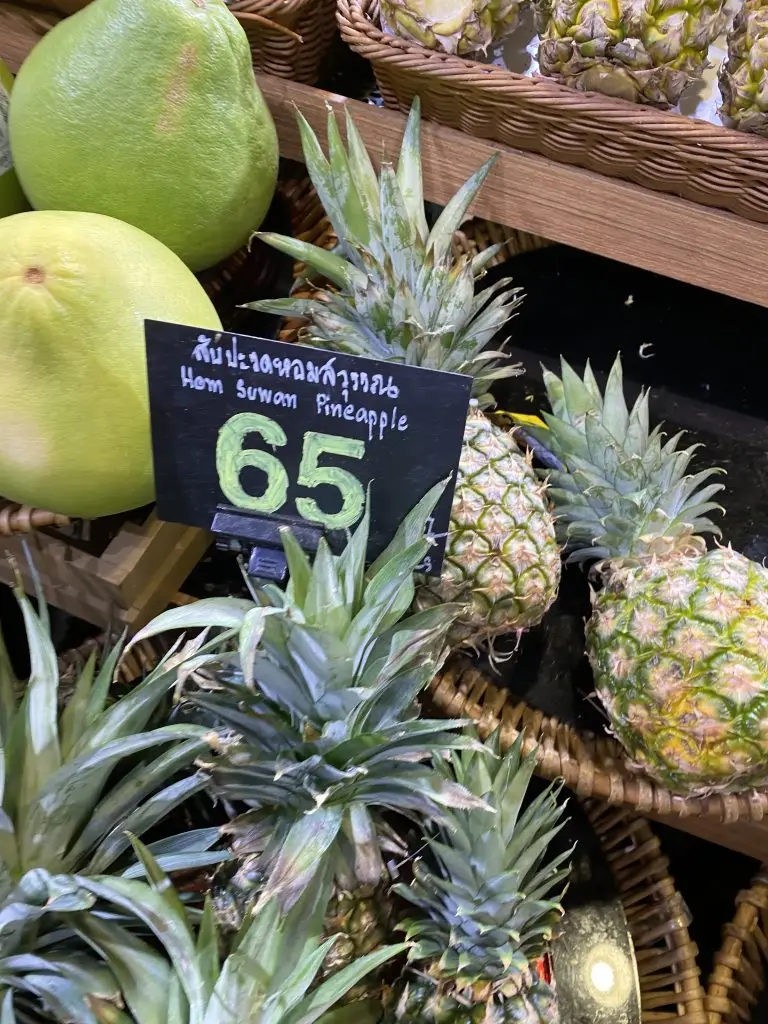
Thailand, beyond everything else, is a land of fruit. 24/7/52 (as it is properly rendered) you can walk out on the street, slide into a Seven (the Eleven is dropped for economy), or hop the neighbor’s fence, and find fresh, ripe fruit. Trucks, piled with (using their English names because, you) rambutan, longan, lychee, and durian, are found half in the street and half on the sidewalk with a PA blaring unintelligibly. Prices are in the equivalent of cents per pound. Avocados – the fruit that screams I’m a Millennial – are a buck each. Or less. The question is never “Do we want a pineapple or some bananas or mangoes?” It’s “What variety of said fruit do we want?” The picture leading this post (or following for some reason if you’re on your phone) is from a convenience store. (Full disclosure: a convenience store in Thailand is nothing like what you’re used to.) Even Thai-grown, single origin, roasted to order, Arabica coffee is available everywhere from street carts to high-end cafés.
Fruit, flowers, and coffee. You literally can’t turn around without seeing one of these. If they’re grown in such abundance and sold at such low prices…
How hard can it be?
The slippery slope to answer that query was stepped out upon last December as we were leaving the resort town of Hua Hin.
“Oh, look. Orchids!” Came the announcement from the passenger seat. “We should stop.”
We screeched to a stop, threw the car into reverse, and backed 200 meters into the approaching highway traffic (normally suicidal, but perfectly acceptable here) to a ramshackle garden center on the side of the highway. Hanging from the rafters were dozens of orchids showing their improbable colors and growth habits, so we got out to look.
In Thailand orchids are grown by tying them to a tree and forgetting you did that until your view from the patio is effectively obscured by a flowery excess rendered in purple, white, and yellow. We found a couple of phalaenopsis plants we liked as well as a huge magenta vanda that was about a meter and a half from the root tips to the top of the flower stalk. The individual flowers were the size of saucers.
Oooohhh…
Exactly.
“How do I transport this?” I asked the helpful proprietor as she counted out the equivalent of eight bucks that the three plants cost.
“Just lay it across the back seat.”
I very gingerly unhooked the immense plant and laid the roots across my free right arm and then supported the leaves and flower stalk with my left. I got into the car and placed the plant down on the backseat as if I were moving the Shroud of Turin.
The next day I woke to hands and arms looking more like the Michelin Man than what I went to sleep with the night before. My fingers and hands contorted like somebody started twisting balloon animals shortly after ingesting a heroic dose of magic mushrooms.
“Oh, shit.”
I soon learned that vanda orchids produce calcium oxalate crystals in their sap as a defensive measure. I had apparently stuck enough of the tiny shards into my skin that my immune system flipped out leaving me in searing pain, sucking down anti-inflammatories and smearing antibiotic ointment over the area that got a nasty skin infection.
Life in the jungle. Amitrite?
At this point, despite some thriving orchids, I decided it was time to try something that was less deadly: pineapples. When I lived in Florida, I had a little pineapple patch that produced two or three a year. Pineapples, thanks to the little pineapple plant sitting atop each one is how you get more pineapples – forever and for free. Take one pineapple, twist off the top, stick it in water to get the roots growing, and eventually put it in some soil and wait.
If you look at the featured image for this post – from a convenience store – you will notice how cheap they are. Really cheap. When I left the Old Country, pineapples were trading for about six bucks each. These are right at the equivalent of US$2.00. That’s expensive. At a market or farm stand they’d be much less.
At that price, why would you want to grow them?
Two reasons. Because it’s fun and instructive to grow your own food. And the qualitative difference between plant-ripened and counter-ripened is significant and worth the effort.
I next turned to that most available of commodities: coffee. Thailand, as with pineapples, has a robust coffee industry. The best varieties are grown in the far north in cool temperate forests high in the mountains. Further south, say, here in Bangkok, there is neither the coolness, shade, nor fog-shrouded morning gestalt that Arabica coffee thrives in. The consensus is that, at best, I might induce a plant or two to grow. Not to produce coffee. Just grow.
Regardless of what the pros said, the plants arrived in due time and I planted them – in pots, everything is easier in pots in Bangkok – and waited.
They are doing great. The roots got established quickly and now all five plants are beginning to branch. Coffee is a beautiful plant on its own, so even if I don’t get a single berry…
… never mind.
I’ll update you when I’m drinking my first cup.
Hope, you see, springs eternal.
Then there was the day when the chainsaws came out.
The neighbors across the street were planning an addition to their house and, as part of the project, took out several massive trees which were happily shading our apartment from the late-day sun. To preserve our shade, we had a fence-like extension added on top of an existing wall upon which to grow some attractive vines. I was cogitating on vine growth and which to plant as I was spooning into a delicious bowl of saowarot sherbet. Saowarot, or as you might know it, passionfruit, grows on an aggressively growing vine that comes with all sorts of warnings about not planting it near any kind of electrical infrastructure lest the weight of the vines and fruit topples said infrastructure resulting in news coverage that begins: “Power remains out tonight for nearly a million people…”
Perfect, I thought. And immediately ordered several from Thailand’s Amazon equivalent, Lazada.
It takes a while for the roots to get established in their new digs, as it were, so growth was neither immediate nor even, but once started it was exactly as advertised. The first vine that woke up has already added about three meters in height and is about to reach the zone above the wall where the sun shines for most of the day. The second vine to get going has added over a meter in the last month and the last is just getting going now. It’s possible to watch them grow. Literally.
My big challenge is going to be keeping them pruned.
And away from the power lines just overhead.