It’s that time of year. Back in March, when the sun made it far enough north in its apparent motion, the vast Asian landmass started warming and the annual monsoon got kicked off. This, being an annual thing, was expected, but for me never having been in Thailand in May, June or July, it was a completely new experience. The pitiless heat of March and April as the sun passes directly overhead is, if you will pardon me plucking some low-hanging fruit, just the warm-up to pump enough of the remaining water out of the ground, and trees, and plants, and reservoirs and into the air where it rises, condenses into clouds, and – eventually – graces the desiccated populace with a few drops of blessed relief.
Once Asia decides to inhale, though, things really start happening. The rising air in Asia starts pulling the H2O saturated air out of the shallow, tepid waters of the Gulf of Thailand and Java and Andaman Seas and into the sun-soaked atmosphere of Southeast Asia. The extra kick of warmth and instability causes that soggy air to rush upwards turning into the towering cumulonimbus clouds that provide a bit of shade from the unremitting insolation and, within a few weeks, start dumping truly prodigious amounts of liquid water into every nook and cranny in the Kingdom. Bangkok receives an average of 167cm (65in) of rain each year with 86% of that falling between May and October.
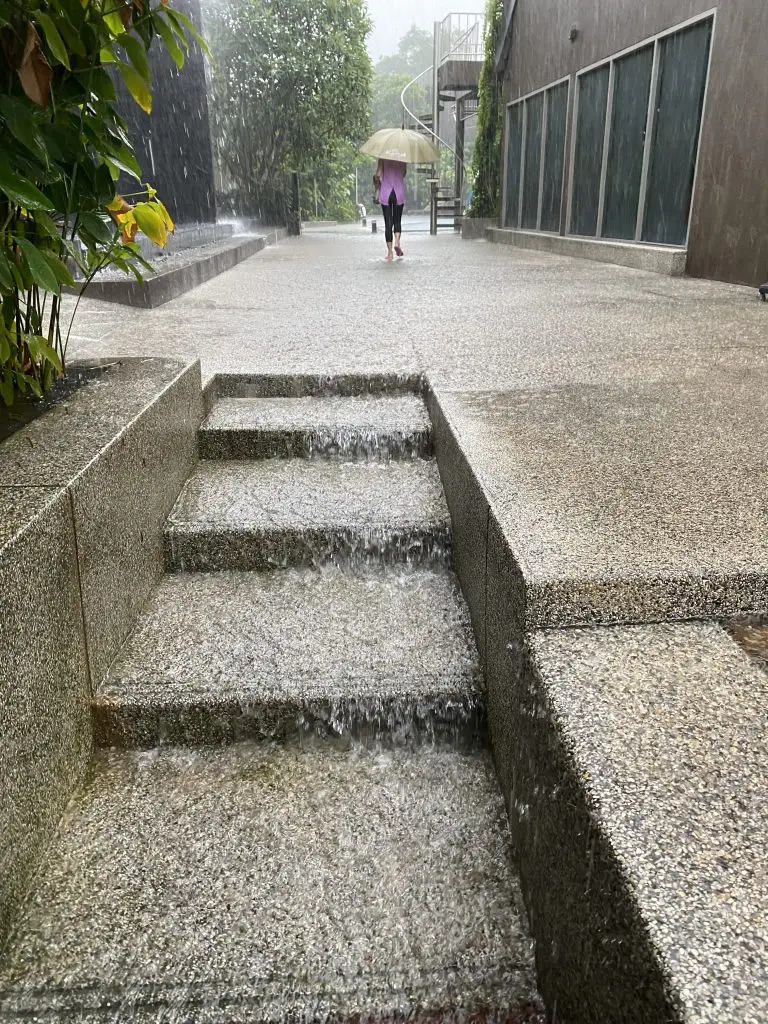
This copious condensate commonly causes cataracts cascading from rooftops along the storms’ paths. And when these waterfalls hit the ground…
…nothing happens.
Bangkok is, basically, flat. Most of the city has an ear-popping elevation of two meters or less. The local water table is equally horizontal and its elevation can be quickly assessed, relative to your elevation, by looking into one of the myriad storm drains scattered about the city. Normally, the water table is close and placid enough to reflect your curiosity right back at you.
So, as millions of metric tons of water plunge into the streets there is simply no place for it to go. It can’t run off because, flat. It can’t drain away because the storm drains max out about five minutes after the first drop hits the pavement, and the rain can’t get into the rivers and canals because those are at – or above – the level of the ground. So, it sits there.
This was brought home to me a few years back. An indelible memory, the water arcing off the roofs of buildings surrounding the storefront shop that produces the best pizza in Bangkok. I had to pull the car into – into – a laundromat to provide a dry-ish place for my partner to get in. When we hit the main road, the water was cresting the sidewalk. By the time we got to our turn we were driving behind a Mercedes in water up to the top of the wheels.
Both things were unfavorable developments.
First off, I have talked about the primary requirement of getting a Thai driver’s license: indecision, before. I have not – yet – delved into the Thai, indeed Asian, fondness for conspicuous consumption. As a Thai person progresses through their career, they will first rent a new apartment. Then they will get a new iPhone. Next, they will buy a new Honda. Then they will buy a new condo. And eventually, their career paths permitting, there will be a new Mercedes in the garage.
With the focus on “new” very few used things are purchased so Thai people are very, very, very careful with their stuff. You see way more well-maintained and repaired cars on the road than you do beaters. The downside is that such protective drivers exhibit a complete inability to assess a situation and then react correctly. Driving down a narrow two-lane road, two cars could be separated by a half-meter and each be a half-meter away from the sides of the road but the drivers are working twelve hour days, six days a week to pay for the cars and never had the time to drive enough to learn how big their cars really are. So, indecision kicks in.
And. They. Just. Stop.
Which left us parked behind the Mercedes, in a tire-deep lake, with the light changing to red. The Mercedes driver – the “indecisive” adjective would be redundant – just stopped. In front of them the lake continued to the horizon. To the left – the turn we wanted to make – was just as bad. So, they froze. My inner New Yorker awoke, and I leaned on the horn to no avail. So, it was helm hard to port and full speed ahead and we left the Mercedes in our wake.
The conditions didn’t improve. In fact, at one point the water was coming up over the hood and then the windshield and then the roof. I so wanted to get it on video but the videographer could not hear my request over the screaming.
We finally made it home by hitching a ride with a neighbor, and the car was fine even though I had to walk back in the morning to collect it. The only adverse reminder of the adventure was a squeak in the brakes that took a week to buff itself out.
So, yeah, rain in Thailand. You get used to it.
But not everybody gets used to it the same.
If you will permit me a canonical diversion, we are told by Matthew in Chapter 5, Verse 45 that God (probably Yahweh, one of two “Gods” in the Christian Bible and the one who admitted to there being other gods) causes the rain to fall on both good people and bad. I’m paraphrasing here as the different versions of the Bible have different translations depending on the target demographic.
Anyway, the Church of Rome’s marketing department decided that Matt’s quote from Jesus’s Sermon on the Mount – Mount Eremos, elevation: -25 meters – meant that God didn’t play favorites – despite the whole premise – and that paupers and billionaires get the same treatment when it comes to watering their crops.
In the Middle East.
Had that sermon been delivered from the Golden Mount in Bangkok the interpretation would have been spun differently. Here, the message would have been: “Look, you’re gonna get rained on so you might as well be rich.”
The difference between what the average Thai experiences when the rains come is on a whole different plane of existence. The Wet Ones are the delivery riders who pull to the side of the road and cover themselves with a transparent rain poncho from 7-11 that is as thin as a dry-cleaning bag so your Pad Thai gets delivered piping hot. They are the construction workers who keep welding rebar as the lightning dances. They are the farmers moved out of their homes and up onto the highway when the river starts to flood, who see their fields flooded and think, Oh, good. It’s time to plant.
On the other hand, as the great well-washed are dealing with their outdoor lifestyle, much of the spray that afflicts them is coming off the wheels of the Mercedes and Luxo-vans transporting the People Who Never Get Wet. These board their cars under cover of their houses, the places they’re likely to go will have roofs over where they are dropped off, and if they happen to need an umbrella, a member of Group A will scurry out of the building with one to escort them to the door.
I mostly travel by motorbike around town, so I’m solidly in Group A, weatherwise. But I do get to park in a garage, so I also never come back to a ride standing in ten centimeters of water with a wet seat to welcome me. I understand the dry-ride sensibilities of Group B even if they are beyond my reach. Sort of like being stuck at the border wall while completely understanding why I’m stuck at the border wall.
Bangkok is a city of rain, but it’s not a city defined by rain. There is a national spirit of “no problem” encoded in the Thai phrase mai bpen rai – “it’s nothing”. It encapsulates the realization that things work out one way or another and on their own schedule. Like the rain. You can expect it about the same time every year. You can prepare for it, as the three small boats sitting out in the carport attest. But you can’t guess how, or even if, it will affect you.
But there was a time, before pavement, when canals made Bangkok the “Venice of the East”. When the water was everything and everywhere. A time, in living memory, when the rain fell on everyone. Equally. In that time of resilience, mai bpen rai was the only way to live. A time before condos and iPhones and motorbikes and Mercedes when everybody knew, no matter how rainy it got…
…that they probably wouldn’t melt.