The camera zooms in on Starfish Beach on the west side of Stocking Island, a long, basically uninhabited barrier off Great Exuma Cay (pronounced “key”) in the central Bahamas. The shoreline is padded with a small flotilla of the pneumatic SUVs of the Cruiser Class: inflatable dinghies. A crowd of – mostly – white people, sporting deep tans and cocktails, mills about a ramshackle, palm frond thatched hut bearing a cockeyed sign identifying the establishment as “Da Sand Bar”. There is but one table. The crowd seems a bit on edge, anticipating that something big is about to happen.
They are not disappointed.
A larger boat arrives, its crew bearing trays and coolers and bag after bag of food. A sigh of relief crosses the beach as the sun-kissed throng realizes that, finally, the party has started. This scene is a regular beach cook-out run by some enterprising locals with access to a boat and a commercial kitchen. Seeing how life aboard a sailboat is 99.9% clinically depressive boredom punctuated by moments of abject terror any – any – diversion is welcomed as a true believer would welcome the Second Coming. And this beach feast is a big, put-it-on-the-calendar-in-red event.
The rickety table is soon groaning under a proper island spread. Bahamian staples like grilled grouper fillet sandwiches with slabs of fish as thick as your wrist, French fries, salad, and, that most Bahamian of Bahamian dishes, macaroni and cheese. The peckish pack of boat dwellers form an orderly queue, and the food service begins.
I found myself standing behind an American woman from a Midwest state and we were chatting amiably, our plates starting to bend under the near kilogram of food being shoveled onto them by the servers. As we reach the end of the line, the woman in front of me glances at her naked fries and asks the server for some ketchup. She then looks away and resumes chatting with me.
Apparently, this was her first rodeo. She was completely unaware that in the Bahamas, as it was with the Reagan administration’s Department of Education, ketchup is a vegetable.
A. Very. Popular. Vegetable.
But unlike here in Thailand, where the locals use ketchup mostly on pizza (get over it), in the Islands of the Bahamas, ketchup is put on absolutely everything. And that is what happened to the woman in front of me. When she looked back at her plate and saw a river of red flooding across her fries, her Mac and Cheese, and even dribbling across her already Ranch Dressed salad, she drew back, aghast, and confronted the server.
“You put ketchup on everything!!!”
“Welcome to the Bahamas, ma’am. NEXT!”
I’m not a fan of ketchup on many things, fries included, so I declined her offer and moved to find a place to sit. The irate American woman came up to me and showed me her plate.
“Look at this mess!” She shouted. “She put ketchup on everything!”
“Welcome to the Bahamas.” I said smiling.
“Well,” she proclaimed. “This is not how we do things at home.”
All of us, whether we want to admit it or not, have our own personal herd of camels. These are the gentle beasts upon which we heap the straw of our pet peeves and personal affronts until the load becomes so great that their back snaps and our ire can be no longer contained by a pile of dried grass.
One of my camels is named Variety and she has a very weak back, indeed. This unsuspecting woman just tossed the single straw needed to crack poor Variety’s spindly spine in twain. I, no longer hobbled by my dear, imaginary ungulate’s gentle eyes and benevolent demeanor was forced to respond.
“Well, if you ******* wanted things to be like they ******* are at ******* home, why the **** didn’t you just stay the **** at home?”
And I wonder why it’s so hard to make friends.
The woman looked like I had just slapped her across the face. Tears glistening in her eyes, she replied.
“I wanted to, but Bob just retired from the Navy and he wanted to go sailing and see the world. I wanted to stay near the grandkids, but he said he’d leave and sail off to Thailand.”
Boo. Hoo. Hoo.
As an aside, this reason why cruising wives were so miserable was so common that it was a trope among cruisers. The few examples of the wives standing their ground and staying at home were related by solo male sailors who, following through on their threats, found themselves alone in some marina bar at the cheap end of a tropical island.
The American woman, now with tear-soaked French fries, wandered off and sat down alone on a rock under a nearby palm tree.
The image of the Ugly American dates to the late 1950s and early 1960s when Americans first started using their post-WWII wealth to travel abroad. Originally, from the book of the same name, the term was descriptive, not pejorative, but Americans are, and were, never above making caustic fun of other American’s foibles, so the script got flipped and Ugly American came to mean Americans abroad ignorant of other cultures, arrogant about their own assumptions, yet unwilling to listen or learn.
Or, as my American queue-mate so succinctly put it: “This is not how we do things at home.”
Because of the Pax Americana that has largely kept the planet intact in the nearly seven decades since the book dropped, that wealth has spread. And, as with Americans, that new wealth allowed more and more expansive travel abroad for people with less and less a reason to do so. In the vast flattening that the Earth has undergone in the past thirty years or so, people who really would be happier if they stayed home, didn’t, and we are all paying the price.
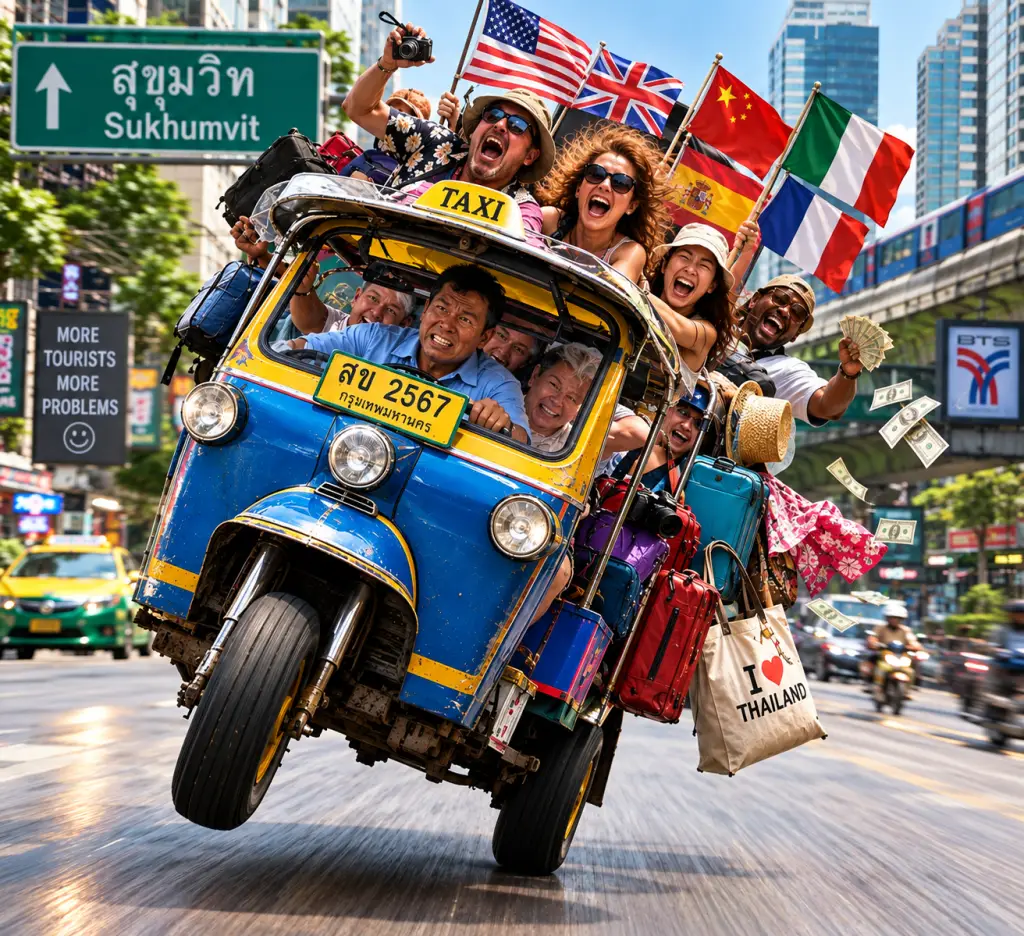
It turns out that travelers, regardless of national origin, are ugly.
Here’s a short list of each country’s distinguishing traits. Qualities so common, that if these were the only thing you knew about someone, you would be able to tell instantly from whence they came.
The Americans – Loud. Unaware that a fancy restaurant’s “Smart Casual” dress code specifically excludes board shorts, printed T-shirts, bikini tops, and flip-flops. Unadaptable. Basic attitude is that if they wanted to speak to Thai people, the Thais should have learned to speak English.
The Brits – Not so loud, but drunk. Come to Thailand so that they’re drunk somewhere other than home. Still pining for the Empire and weep when looking at a regional map. Convinced that things were better at home in Victoria’s day than they are now in Thailand. Cargo shorts, wife-beaters (vests, I think they call them?) and black socks with sandals. Become irate when confused with Australians.
The French – Subdued. Very happy to be in Thailand but missing the universal existential gestalt that a shrug can bring to a conversation. They dwell in enclaves noted for their baked goods. Basic attitude is that they can’t wait to leave.
Russians – At least it’s not Ukraine.
Ukrainians – At least it’s not Ukraine.
The Italians – “Fuck you.” Also loud. General attitude is that they can take their money elsewhere. Most do.
Australians – Like Americans, but they actually do dress like that at home, so not aware that there is an option. Many have lived in Thailand for years without trying anything more adventurous than pad Thai. Not surprising considering that “Australian cuisine” is what everybody else on the planet calls “sandwiches”. Become irate when confused with Brits. General attitude is that the beaches suck here.
Middle Easterners – Bro, your hotel really doesn’t have a shower? The only visitors that I’ve seen denied entry to a business in Thailand, just because.
Indians – Always travel in large family groups that can sweep a sidewalk clear of other pedestrians. Many fun festivals with great food but which are largely inaccessible due to the accumulation of large family groups. Frequently complain about the beaches as the sand is not sufficiently sturdy enough for large family groups.
The Chinese – Sigh… Sadly, the luggage-dragging Chinese have become the true inheritors of the Ugly mantle. They are pushy, whether cutting in line at a store or, as happened to me the other night, knocking everybody out of the way coming down the stairs from the SkyTrain. It has become almost a service standard that employees in Thai businesses will apologize about the behavior of Chinese patrons. “Welcome to Somchai’s Noodle Palace. We’d like to offer apologies for the conduct of our other diners.” No. Really. General attitude is, get out of our way the tour bus is leaving.
While that is a brief look at the baggage everyone carries to Thailand, there is a mantra that I find helps me not to be ugly. Each morning, I look into the mirror, stare deep into my eyes, and repeat. “Today it will not be me.”
About half the time it works.