Enough already. It’s time to pause, however briefly, the circular it-works-that-way-because-that’s-how-it’s-always-worked reasoning of the Thai language. It’s time to step back from the worrying implications of exactly how fragile a system we live in with its foundation built on things less substantial than sand. And it’s time to look away from the now mundane aspects of my soon-to-be year-long stay in the Kingdom of Thailand and answer the question:
Why is she just standing there?
Thailand is and has been, since its consolidation in the late 1700s, a highly structured society in which the branches of power – the royalty, the military, and the economic elites – have maintained an uneasy truce with the vast majority of the population. The truce is maintained by a tacit agreement, in its current form, that the powers will provide access to jobs, medical care, and limited opportunity for advancement in exchange for shutting the fuck up about the new clothes, already.
Please note, blog posts here will frequently make reference to setups started in earlier posts. I do this because 1) it helps with engagement if you have to read something I wrote fifteen years ago to get the joke I just made, and 2) it’s a way of talking about things that I may not write about under pain of deportation, or worse.
The truce is managed by the societal norms established by the Theravadan Buddhist administration that wields its influence through a network of over 40,000 temples in the country. The argument here is that your life in this time is determined by all the things you did in all your previous lives as whatever morality-ambiguous species you were which were all tallied in your Karmic ledger which brings you up to now. This concept is musically detailed in the song Galileo by the Indigo Girls. Sort of like: You have the life you have because that’s the life you’re supposed to have, prove me wrong.
This concept is exactly like the Downton Abbey-esque “station in life” model, plus ghosts, spirits, and incense. You are born to your station in life – upstairs or down – so deal with it.
Now, modernity has wrought a few changes in both the West and East so that servitude, as it were, is currently a career “choice” rather than a genetic imperative. At least at first glance. But there are differences. In the west, particularly in the United States, service jobs are considered more along the line of fill-in or fallback kinds of employment. You will find very few people who say “Goddamn, I love getting up in the morning and going to the restaurant to drop plates full of ham sandwiches in front of my ungrateful diners and I hope to do it for another thirty years.”
It’s less like that in other places, where a career in service, particularly low-skill service, is entirely normal.
Thailand does have a curse, though. It has, despite a somewhat medieval social structure, a booming economy. This society is managed by a group of people who – as with every government on the planet – probably should be waiting tables but, nonetheless. They also have the problem that the people they need to keep everything running smoothly do not exist in the numbers required from the more socially acceptable levels. They have to dip into the pool of Karmic misfits to educate up a bunch of people who in previous incarnations would have been stuck tending a rice paddy until their buffalo died and collapsed on top of them in the mud.
Thailand has a robust educational system with a wide variety of affordable universities that can bring up and coming members of the next generation online to keep things humming along. But there’s a long-term price to be paid. For example, if you want to become a doctor in Thailand, it’s free. The catch is that you are required to work, for low wages, several days a week in state-run hospitals and clinics to pay off your debt to society. The other days you are free to pursue your career in the more lucrative private hospitals that are the global draw for medical tourists and wealthy Thais. This means the rest of Thai society gets the same skilled medical care for a tiny fraction of the cost of private because they’re not needing to underwrite the purchase of German luxury cars or international schools for the doctors’ kids.
But what do they do, these government-healthcare Thais? The same as everywhere else: they keep the place functioning. Maybe not efficiently, but functioning. They grow the food, build the stuff, maintain the infrastructure, work in stores, provide the endless hordes needed to keep a host of different bureaucracies from being buried under the tons of paper they generate each minute, and they serve your food, and clean up the remains of your meal. Even at McDonalds.
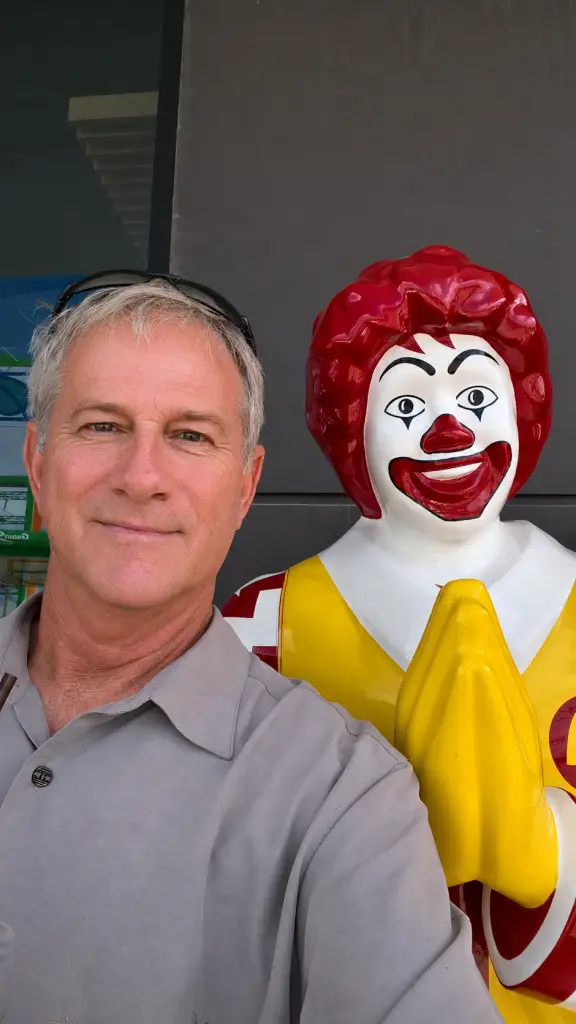
That’s right, Micky-D’s. Order, take a seat, and your quarter pounder with cheese will be brought to you and, when you are finished, the tray and wrappers will be cleared away. Ronald is even there to wai you out the door.
The reason for this goes back to the inter-class social agreement I mentioned earlier. That compact comes down to this: the economic elite will provide jobs to anybody who needs one to make sure that nobody needs to starve or become a rabble-rouser.
There is, basically, no welfare system in Thailand beyond government supported healthcare. The thin cracks that “basically” implies are papered over with benefits so slight that truly needy people make the majority of their living from recycling. Desperately poor people coexisting alongside others isolated in traffic while the batteries in their Porshe Taycan slowly creep to zero percent just from running the air conditioning, is never a good mix. And that’s why the agreement was created.
There are, of course, downsides to this agreement. For the economic powers, they are paying for a lot of people that they don’t need. Imagine walking into a Home Depot, Costco, or whatever your local big-box store is and always – always – finding sales staff that exist in a ratio to customers of 1.5:1. Or more. Always. Someone will be ready, willing, and able to find anything you want, to guide you through the store, to go find you a better cart, and – once filled – push that cart to the checkout and out to your car. I was at HomePro – like Home Depot only without the lumber – once and was looking at garden hose fittings. The retail leech, er… helper that was hovering next to me asked if I needed anything else. I mentioned something and she vanished in a flash, only to return a few moments later with one of each type of my next-item-on-the-list that the store offered. I chose one and she put it in the cart, then she just dropped the ones I didn’t want – so I wouldn’t have to wait while she put them back – and pushed my cart, carrying a total of about 500 grams (one-ish pounds), to the checkout counter.
So, useful? Yeah. But, annoying? Also, yeah.
The worst example of this annoying behavior, and the one most frequently encountered, are servers at restaurants. They take you to your table, hand you a menu, and then just stand there until you’re ready to order. If it’s a big menu, or you are, as I am, a slow reader, they might eventually get tired and squat down to get more comfortable. So, there they are, their face at tabletop level, an iPad in one hand, and their large, brown eyes looking up at you as if to say…
“Would you hurry the fuck up.”
So, to answer my original “Why is she standing there?” question, she is standing there to make sure you don’t have to wait an instant between when you make up your mind and when she keys your Pad Thai into the iPad. That’s her job and she’s gonna do it.
It is still annoying. And trying to make it less so tends to backfire. If you tell her to wait a second, she just stands there anyway. I mean, a second’s not long, is it? But, if you tell her you need a few minutes to look at the menu, it will seem like she took her break in Bolivia.
The ever-inventive Thais have come up with a trick to take care of this. Across the country, all restaurants share a few common dishes, things like spring rolls, French fries, and pizza. No, really. The trick is to get escorted to your table, handed your menus, and then immediately say…
“We’d like to start with the pepperoni.”
This gives you all the time you need to peruse the menu, decide on drinks, and just relax before the piping-hot pizza is delivered and you can place your real order.
And the pizza?
You just get it boxed up to take home.